
Calamity Jane.
Queensland Theatre – The Events Centre, Caloundra
There is something enduring about a musical that refuses to take itself too seriously while offering audiences a generous helping of romance, humour, larger-than-life characters and unpredictable musical theatre. Calamity Jane, recently presented by Queensland Theatre at The Events Centre, Caloundra, deliberately challenges the conventions of traditional musical theatre.
Based on the much-loved 1953 Warner Bros. film starring Doris Day, the musical transports audiences to the colourful world of Deadwood, South Dakota. At its centre is the irrepressible Calamity Jane, a sharp-shooting, outspoken frontier woman whose independence, bravado and unconventional approach to life provide plenty of comic opportunity, while concealing a more vulnerable and romantic side.
The journey of this musical to its current 2026 incarnation is an interesting one. From its Hollywood origins in the 1950s, through its stage adaptation in the 1960s, to Richard Carroll’s reimagining for the Hayes Theatre in Sydney in 2017, Calamity Jane has undergone considerable theatrical reinvention.
From a programming perspective, this reincarnation of Calamity Jane is something of a sure bet for Queensland Theatre. It is a production with proven audience appeal and a track record of success, honed over several years as it has travelled around Australia under the leadership of Sydney-based director and producer Richard Carroll.
What began as a reading at the Hayes Theatre has developed into a fully realised, polished touring production. It offers an interesting example of how a work can grow through performance, experimentation and the accumulation of touring experience, finding its theatrical identity along the way. This is not simply a revival of a familiar musical; it is a work that has been revisited and refined.
From the moment audiences arrived at The Events Centre, it was clear that this was not going to be a conventional night at the theatre. Staff greeted patrons dressed in an assortment of Western cowboy garb, while two bales of hay in the foyer provided an immediate sense of the Wild West. One couldn’t help but wonder what the cleaning staff might think about their post-season responsibilities!
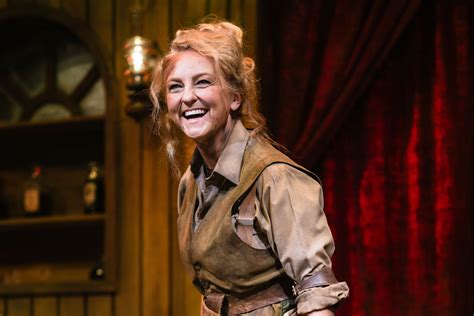
Visually, the production has a wonderful warmth. Festoon lighting hangs above the saloon and extends out into the auditorium, helping to dissolve the boundary between the playing space and the audience. The warm, earthy tones of the set, the costumes and their lived-in Western aesthetic, right down to the dirt on Calamity’s face, contribute to a convincing theatrical world. Nothing feels overly polished or artificially pristine. The design choices are cohesive, considered and entirely in keeping with the production’s honky-tonk sensibility. This is a resolved work. Its visual language, performance style, musical presentation and audience engagement sit comfortably together. Even when the venue presents challenges, the production knows what it is and what it wants to achieve.
Directed by Richard Carroll, this production takes a deliberately unpretentious approach to the familiar musical. And that is precisely where much of its charm lies. Despite the cavernous space and the acoustic challenges of what is essentially a large function room with a stage at one end, this seasoned cast gave the production everything they had. Their irrepressible energy and commitment ensured that the audience was drawn into the world of Deadwood.
Naomi Price leads the ensemble as Calamity Jane, a role that requires considerable comic timing, physical confidence, vocal ability and the capacity to move between boisterous frontier humour and genuine emotional tenderness. Price is captivating. She is undoubtedly the engine of this production. She sets the energy bar, establishes the tone and gives the ensemble permission to be bold, playful and gloriously unrestrained. Her warmth and generosity as a performer make the audience feel included rather than simply entertained. She understands the value of a knowing glance, an unexpected aside and a moment of direct engagement.
For those who had paid extra to secure a seat on the stage, inside the actual saloon, Price was pure charm. She has an infectious stage presence and, perhaps most importantly, an ability to make an audience feel comfortable and welcome.
One of the production’s greatest strengths is its immersive quality. This is not a musical that keeps its performers safely contained within the boundaries of the stage. The actors frequently travel through the auditorium, positioning themselves amongst the audience and drawing patrons into the action. At times, the distinction between performer and spectator becomes wonderfully blurred. Price’s Calamity Jane seems particularly at home in this territory, often standing with one foot on the stage and the other firmly planted in the audience. It is a lovely physical expression of what this production is trying to achieve: breaking down the fourth wall and inviting everyone into the world of Deadwood.
From the clip-clop arrival of imaginary horses, created with two half coconuts in a wonderfully Monty Python-esque moment, to the actors’ knowing asides explaining the use of multi-rolling, where one performer takes on several different characters, the audience is invited to share in the theatrical mechanics rather than simply observe them. There is a refreshing honesty in this approach. The production doesn’t pretend to be something it isn’t; instead, it celebrates the artifice, the playfulness and the sheer joy of making theatre.
The ensemble is particularly strong. Andrew Buchanan brings warmth and charm to Henry Miller, while Laura Bunting’s Katie Brown provides an appealing contrast to Jane’s unruly personality. Juliette Coates demonstrates impressive versatility in her multiple roles, while Darcy Brown brings comic mischief as Francis Fryer. Anthony Gooley’s Wild Bill Hickok provides an engaging counterbalance to Jane’s larger-than-life personality, and Sean Sinclair completes the romantic entanglements as Lieutenant Danny Gilmartin.
There is a wonderful honky-tonk quality to the musical presentation. The cast, accompanied by a single piano player, creates a soundscape that feels intimate, immediate and distinctly old-fashioned in the best possible sense. Without the weight of a large orchestra, the musical arrangements have a pared-back, saloon-style quality that complements the production’s playful aesthetic. The performers carry much of the musical and theatrical energy themselves, creating an atmosphere that feels closer to a lively night in a Western drinking establishment than a conventional night at the musical theatre.
Arriving at Caloundra as the second last stop on a Queensland tour, the production has clearly developed a strong sense of its own theatrical identity. Yet touring brings its own compromises. The cavernous space at The Events Centre posed challenges, particularly in maintaining the intimacy that this production seems to thrive upon. I found myself longing for the intimacy of the Hayes Theatre, where Carroll first staged this reimagining in 2017. Some productions simply benefit from the closeness and atmosphere of a smaller space. The touring company deserves credit for embracing the space and making it work, even if I occasionally wished for a little more breathing room. The decision to sell stage seating was not without its challenges. While placing audiences inside the saloon is an appealing concept, it did create some sightline difficulties and, at times, the additional bodies tended to crowd the stage and the action. I found myself pining for a wider stage and more traditional raked seating throughout the auditorium. But this is the reality of touring. Every venue presents a different set of challenges.
At times, the first half felt as though the stagecoach had bolted and the horses were struggling to keep up. The pace and energy were relentless, with one comic moment tumbling into the next. I found myself wanting a little more light and shade, a little more breathing space and, in particular, one slower musical moment that would allow us to connect more deeply with Calamity and her aching heart. Beneath all that bravado is a woman who longs to be loved and accepted. It is this vulnerability that gives the character her humanity, and I wanted a little more time to sit with it.
Thankfully, the second half delivered more of this emotional subtlety. There was a welcome shift in tone, with moments that allowed the emotional landscape of the characters to emerge. The more poignant treatment of The Black Hills of Dakota offered a welcome contrast to the exuberance elsewhere, reminding us that this musical has more to offer than its comedy and high-energy musical numbers.
The musical score remains a significant attraction. Familiar favourites including The Deadwood Stage, The Black Hills of Dakota, Just Blew in from the Windy City and Secret Love provide a nostalgic connection to the original film while allowing the performers to explore the music within this fresh theatrical framework.
And then there is the wedding reception! Audiences are invited to continue the celebrations in a room adjacent to the theatre, where the spirit of Deadwood is extended beyond the performance itself. It was genuinely fantastic to see audience members, both young and old, kicking up their heels, joining in the festivities and embracing the occasion. It was a lovely reminder that theatre can be more than something we watch; it can be something we actively participate in.
But perhaps the bigger question is whether Calamity Jane still has something relevant to say to contemporary audiences. More than six decades after its stage origins, there is an interesting tension between the nostalgia of the original material and the desire to present it in a fresh and unconventional way. Jane’s independence, refusal to conform and determination to find her own place in the world remain appealing. Her story of belonging, friendship and the desire to be loved is hardly dated.
There is nothing particularly serious about this production, and that is not a criticism. It is delivered with humour, polish and panache. It knows exactly what it wants to be: an entertaining, generous and thoroughly enjoyable theatrical experience. Yet I would have welcomed a little more stillness among the exuberance, allowing the audience to discover the heart beneath the bravado.
Ultimately, this Calamity Jane succeeds because of its generosity of spirit. This production presents a worthy case study proving that theatre is at its best when performers and audiences share the experience. With Naomi Price driving the action, a talented ensemble moving freely between stage and auditorium, and a single piano providing those irresistible honky-tonk vibes, this is a spirited celebration of live performance.
Review by Dr Sharon Hogan
Image credit : Queensland Theatre Company